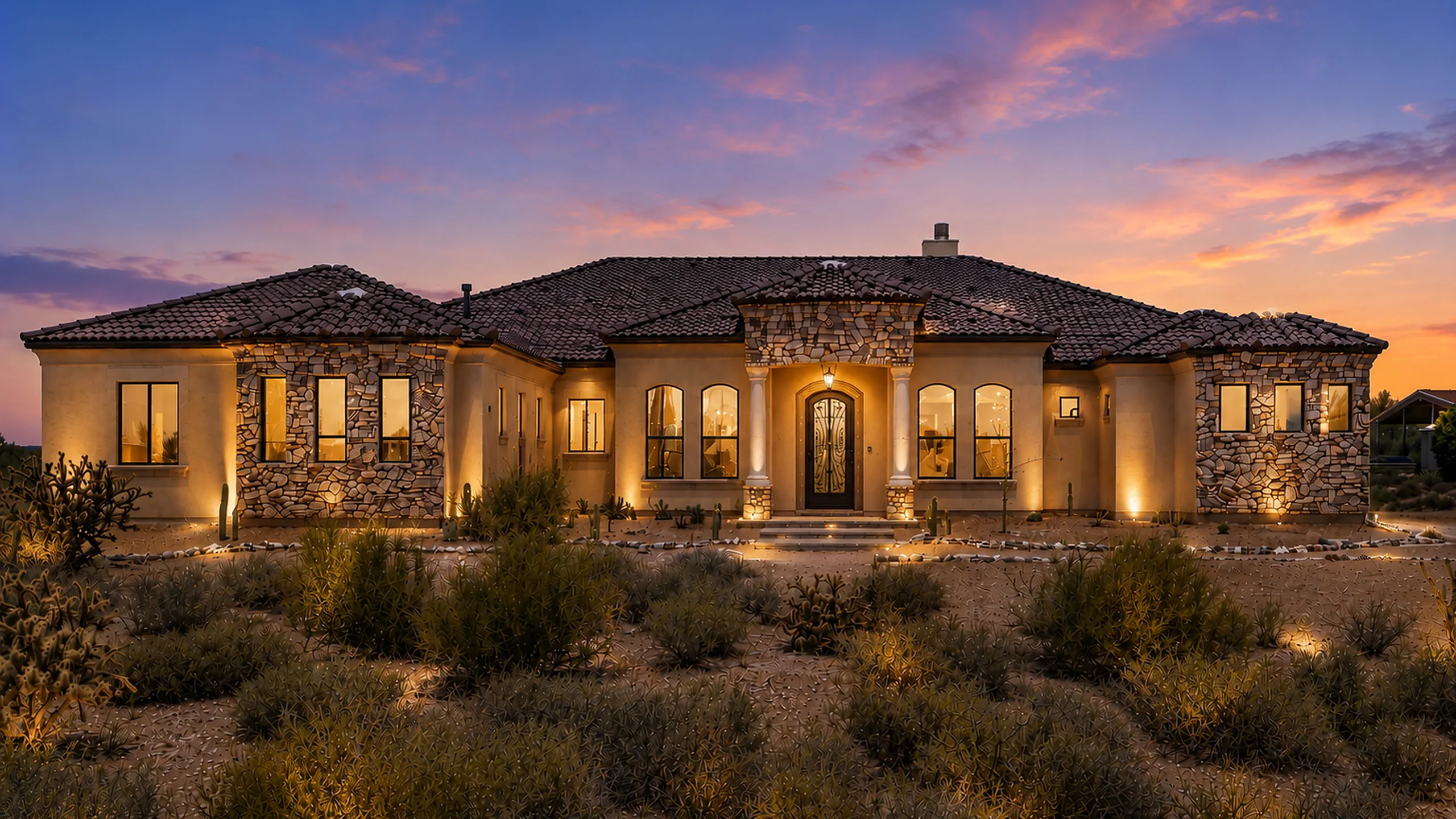

If you’re considering building a luxury custom home in Scottsdale, there is a good chance one of your first questions is:
What should I expect to spend?
You deserve a better answer than “it depends.”
And you also shouldn’t feel like you need to have every detail figured out before you can begin getting useful answers.
For a luxury custom home in Scottsdale, a reasonable early planning range is often approximately $400 to $700+ per square foot for construction, with highly complex, extensively detailed, or difficult-site residences capable of moving considerably higher.
That is useful information.
It is not, however, a budget.
And understanding the difference early can make the entire design and building process feel considerably more manageable.
Start With the House, Not Just the Square Footage
Imagine two 6,000-square-foot homes.
The first is built on a relatively level homesite with straightforward access. It has clean architectural forms, conventional structural spans, beautiful but disciplined finishes, and a thoughtfully designed outdoor environment.
The second sits against a mountainside. It requires substantial excavation and retaining, incorporates large expanses of glass, disappearing doors, long structural spans, extensive custom millwork, imported stone, sophisticated lighting and automation, and an elaborate pool and landscape package.
They’re both 6,000 square feet.
They aren’t remotely the same construction project.
That’s the limitation of asking only for a cost per square foot.
The better question is:
What will it cost to build the home I actually want, on the property where I want to build it?
That is the question we try to answer as early as possible.
Not because every decision needs to be made immediately, but because a little clarity early tends to make every decision that follows easier.
A $4 Million Budget Should Not Become a $6 Million Design
This sounds obvious.
It happens more often than it should.
One of the biggest advantages of involving the builder early is that construction cost can become part of the design conversation rather than something discovered after the design is substantially complete.
If an owner establishes a construction target of $4 million, the architect, builder and design team should be making decisions with that number in mind from the beginning.
That does not mean designing a lesser home.
And it does not mean taking the excitement out of the process.
It means giving the owner enough information to make intentional choices while there is still plenty of flexibility.
Perhaps the priority is extraordinary architecture and glass.
Perhaps it’s the kitchen and entertaining spaces.
Perhaps it’s an exceptional primary suite.
Perhaps it’s a resort-level backyard.
Perhaps it’s all of those things, and the appropriate budget is higher.
Those are productive conversations to have during design.
They’re much less enjoyable after months of work have produced a home that costs significantly more than the owner intended to spend.
Our preference is to help make those conversations clear early, without making the process feel restrictive.
The Homesite Can Move the Budget Before the House Even Starts
In Scottsdale, the property itself can have an enormous impact on construction cost.
A relatively level homesite with good access and accessible utilities is one thing.
A hillside or constrained site involving significant excavation, rock, retaining structures, drainage requirements, specialized foundations or difficult construction access is something entirely different.
And some of the most extraordinary homesites in Scottsdale are extraordinary precisely because they aren’t simple.
That doesn’t make them bad lots.
It simply means the cost of developing the property needs to be understood before treating the house budget as though every dollar is available for the house itself.
This is one reason we prefer to look at a property early.
A homesite shouldn’t just be evaluated for its view and location.
It should also be evaluated for what it is going to ask you to build.
For many owners, simply understanding that before design begins provides a great deal of confidence going into the next step.
Architecture Has a Price
Some architectural decisions are inexpensive on paper and expensive in the field.
Long cantilevers.
Large unsupported spans.
Floor-to-ceiling glass.
Pocketing door systems.
Complex roof structures.
Oversized slabs of stone.
Floating stairs.
Highly detailed exterior transitions.
Structural steel.
Custom fabricated elements.
None of those are reasons not to do something.
This is a custom home.
The entire point is to create something that isn’t ordinary.
Our role is not to talk you out of the things that make the home special.
It is to help you understand what those decisions mean while there is still time to make them thoughtfully.
Sophisticated budgeting means understanding that architectural decisions have construction consequences.
Our preference is not to remove the things that make a house special.
It is to identify them early enough that the owner can consciously decide which things deserve the investment.
Finish Level Matters—But Not in the Way Most People Think
People sometimes imagine “luxury finishes” as a single level.
They aren’t.
Consider the kitchen alone.
One luxury home might include very good custom cabinetry, premium appliances, stone countertops and high-quality plumbing fixtures.
Another might include extensively detailed millwork, concealed appliance integration, stone-clad walls, specialty metal fabrication, imported materials, multiple kitchens, a back kitchen and a completely customized lighting package.
Both would reasonably be described as luxury.
Their costs can be dramatically different.
Now extend those decisions throughout an entire residence:
- flooring
- cabinetry
- countertops and stone
- plumbing fixtures
- appliances
- windows and exterior doors
- interior doors and hardware
- lighting
- fireplaces
- millwork
- wall finishes
- closets
- automation
- specialty fabrication
There isn’t a universal luxury specification.
There is your specification.
And you do not need to know all of it on day one.
A good early budgeting process simply starts helping you identify which parts of that specification matter most to you.
That’s why a realistic budget becomes substantially more accurate once the team understands not simply how big the home will be, but how you expect the home to feel.
In Scottsdale, the Backyard Is Part of the House
This is another place where early budgets can go wrong.
Someone establishes a construction budget for a 6,000-square-foot residence and then begins adding:
a pool and spa,
covered outdoor living,
landscape architecture,
mature specimen trees,
outdoor kitchen,
fire features,
site walls,
gates,
hardscape,
exterior lighting,
water features,
sport areas,
and substantial grading or retaining.
On a luxury Scottsdale residence, the exterior environment can represent a significant investment in its own right.
And it should.
For much of the year, the outdoor spaces are effectively additional living rooms.
So when we talk about the cost of creating a property, we would rather discuss the entire property than give you an attractive house number and introduce the rest later.
That approach may not always produce the smallest number in the first conversation, but it usually produces a much more comfortable process later.
Then There Are the Costs Outside the Construction Contract
Before comparing one builder’s number to another, make sure everyone is actually pricing the same thing.
Depending on how the project is structured, the overall investment may also include:
- architecture
- interior design
- structural and civil engineering
- surveying
- geotechnical work
- landscape architecture
- permitting and plan review
- HOA or community design review
- specialty consultants
- furnishings and art
- certain utility or infrastructure improvements
Some may be included within a builder’s budget.
Others may be contracted directly by the owner.
Neither approach is inherently better.
What matters is knowing the difference.
A lower number isn’t actually lower if several hundred thousand dollars of anticipated scope is simply sitting outside of it.
Clear expectations here tend to remove a lot of unnecessary anxiety later.
So, What Number Should You Use?
For very early planning, cost per square foot can still be useful.
Just use it for what it is:
a screening tool, not a price.
If you’re envisioning a luxury custom home in Scottsdale, beginning the conversation somewhere in the $400–$700+ per-square-foot construction range is a reasonable place to start.
A home toward the lower end of that range will typically require a different combination of site conditions, architecture, size and finish decisions than one toward the upper end.
And some projects will move beyond it entirely.
A highly detailed architectural residence, an exceptionally difficult homesite, extensive structural engineering, significant site development, or a home incorporating substantial bespoke materials and craftsmanship can push construction costs well above $700 per square foot.
The goal at the beginning isn’t to predict the final contract price to the dollar.
The goal is to determine whether the home you’re envisioning and the amount you’re comfortable investing are reasonably aligned.
And if they are not perfectly aligned yet, that does not mean the project is off track.
It simply means you have learned something important early enough to do something about it.
That’s something a good team should be able to help you understand surprisingly early.
A Better Way to Begin
In our process, we prefer to start with four things:
1. The property
Where are we building, and what does the homesite require?
2. The architecture
What kind of residence are you envisioning?
3. The priorities
Which parts of the home matter most to you?
4. The investment
What amount are you comfortable committing to the project?
You do not need perfect answers to all four.
You simply need enough of a starting point to begin having an intelligent conversation.
From there, the process becomes much more useful.
If the vision and budget appear well aligned, move forward.
If they’re not, that isn’t necessarily a problem either.
It simply means the team can make intentional decisions while those decisions are still inexpensive to make.
Maybe the house becomes slightly smaller.
Maybe the architecture becomes more efficient.
Maybe certain finishes change.
Maybe the outdoor program is phased differently.
Or maybe everyone decides that the original vision is worth increasing the investment.
Those are choices.
Discovering late in the process that the home was never compatible with the budget isn’t.
What Bella Legacy Believes About Budgeting a Custom Home
We don’t believe the job of an early construction budget is to produce the lowest possible number.
And we don’t believe owners benefit from an unrealistically precise number before enough is known about the project.
The goal is to establish a credible working budget that gets more precise as the design develops.
That means asking harder questions early.
Looking at the property.
Understanding the architecture.
Discussing finish expectations.
Thinking about the exterior environment.
Identifying the expensive decisions before they become expensive changes.
And continually comparing the evolving design to the owner’s intended investment.
But it also means remembering that this is supposed to be an exciting process.
The numbers should help you make better decisions, not make you feel like every idea is a problem to solve.
Our job is to create enough clarity around the budget that you can enjoy the creative part of building a custom home with greater confidence.
Because the best time to solve a budget problem is before it becomes one.
Considering a Custom Home in Scottsdale?
You don’t need completed architectural plans to begin a meaningful conversation with Bella Legacy.
In fact, earlier can be better.
If you already own a homesite, we’re happy to look at it with you.
If you’re evaluating land, we can help you think through the construction implications before you purchase.
And if you’re already working with an architect or designer, we can become involved early to begin developing realistic construction expectations as the design takes shape.
There is no expectation that you arrive with everything decided.
Part of our role is helping you turn a collection of ideas, priorities and questions into a clearer path forward.
The objective isn’t to tell you what you should build.
It’s to give you enough information to make better decisions about the home you want to build.
If you’re considering a custom home in Scottsdale and would like to begin discussing the property, the design or the investment, Contact Us to start a conversation with Bella Legacy.
Related: Building a Custom Home in Scottsdale: A Step-by-Step Guide
Related: How Long Does It Take to Build a Luxury Custom Home in Scottsdale?
Related: What Does a $1.5 Million Custom Home Construction Budget Buy in Scottsdale?